Centers, Labs, Groups
In research labs and groups across UVA Engineering, our faculty and students are making discoveries and disseminating their breakthroughs across the globe.
-

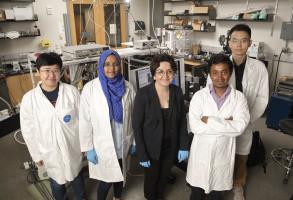
Dolatshahi Systems Immunology Lab
We develop new systems biology approaches to understand fundamental mechanisms of immune regulation and dysregulation, with an ultimate objective of identifying strategies to design and improve immunotherapies -
-
-
ELM Research Group
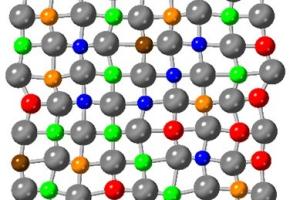
Our group, led by Keivan Esfarjani, performs design, modeling and atomistic simulation of materials for energy conversion and storage using first-principles density functional theory (DFT) calculations and quantum and statistical mechanics tools. -

Environmental Resilience Institute
The Environmental Resilience Institute brings together UVA faculty, students, and external partners to conduct trans-disciplinary research at the intersection of environmental change and human wellbeing. The institute’s overarching goal is to identify solutions to some of society’s most challenging and complex social-environmental problems. UVA Engineering Representatives: Andres F. Clarens and Jonathan L. Goodall. -

ExSiTE Lab
Our group’s interests are in energy transport and coupled photonic interactions with condensed matter, soft materials, liquids, vapors, plasmas and their interfaces. We use various optical thermometry-based experiments to measure the thermal conductivity, thermal boundary conductance, thermal accommodation, strain propagation and sound speed, optical properties, and electron, phonon, vibrational and polaritonic scattering mechanisms in a wide array of bulk materials and nanosystems. -
Fluids Research and Innovation Laboratory (FRIL)
Our projects focus on unsteady fluid dynamics, including micro- and nano-texturing coatings for self-cleaning, fluid dynamics and heat transfer of energy-storage systems, inlet aerodynamics of supersonic aircraft and inlet particle separators of helicopters, and bio-inspired morphing wind turbines to reduce off-shore cost of energy -

Ford Group
Our research focuses on the application of chemical engineering principles to problems in microbial ecology. The aim is to develop a fundamental understanding of mechanisms underlying microbial behavior which will provide insights for future technological innovation. -

Formal Human Systems Lab
Dr. Bolton and the formal human systems laboratory study why engineered systems fail and how to prevent failures through human-centered systems engineering. Dr. Bolton is an expert on the use of formal, mathematical methods in human factors engineering, particularly for discovering engineering oversights that lead to human behavior, error, and cognition contributing to failures. Methods developed in the lab are applied to safety-critical applications in aerospace, medicine, defense, and cybersecurity. -

Gerling Touch Lab
My lab's research interests surround the interface of people and machines - focusing in particular on the sense of touch. My group mixes computational modeling efforts with the design and prototyping of devices with which people directly interact. Our research is highly collaborative and interdisciplinary. Our emphasis lies primarily in the domain surrounding human health. Our research tends to be published at the intersection of haptics, computational neuroscience, human factors and biomechanics.